
Content Marketing Services – Multimise
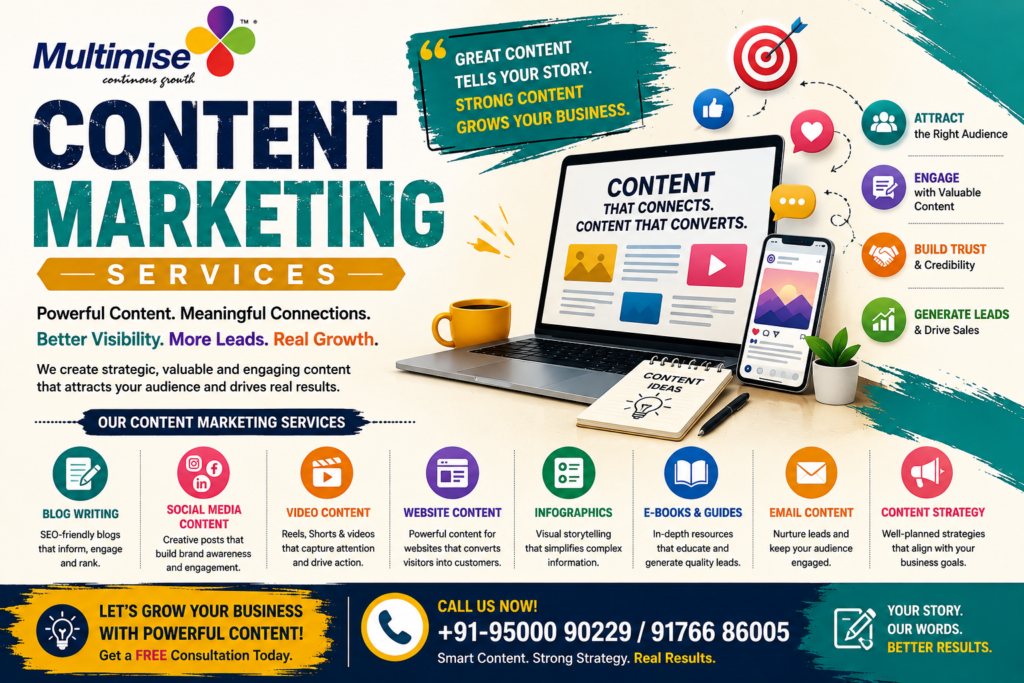
Content Marketing That Builds Trust, Attracts Customers and Drives Growth
In today’s digital world, customers do not simply buy products and services. They research them first.
Before contacting a business, a potential customer may search Google, read a blog article, watch a video, visit social media, compare competitors, look at customer reviews and explore the company’s website.
This is where content marketing becomes important.
Content marketing helps your business provide the right information to the right audience at the right stage of their buying journey.
At Multimise, we create strategic content designed to help businesses attract attention, educate their audience, build trust, improve online visibility and generate business opportunities.
Our content marketing approach combines strategy, research, creativity, SEO and digital marketing to create content that supports your overall business goals.
Create Better Content. Reach the Right Audience. Build a Stronger Brand.
What Is Content Marketing?
Content marketing is the process of creating and distributing useful, relevant and valuable content to attract and engage a specific target audience.
Content can take many forms, including:
- Blog articles
- Website content
- Social media posts
- Instagram captions
- Reels
- YouTube Shorts
- Videos
- Infographics
- Case studies
- E-books
- Guides
- FAQs
- Email newsletters
- LinkedIn articles
- Product descriptions
- Service pages
- Landing page content
The purpose is not simply to create more content.
The purpose is to create the right content for the right customer.
Why Content Marketing Matters
Imagine someone is planning to renovate their home.
They search online for:
“Modern interior design ideas”
They discover a useful article.
Later, they search:
“Best interior designers in Chennai”
They find a company’s website.
Then they see the company’s Instagram Reels showing completed projects.
Finally, they contact the company.
Content may have influenced that customer’s journey from research to enquiry.
This is the power of strategic content marketing.
Content Marketing for Every Stage of the Customer Journey
A good content strategy should support customers at different stages.
Stage 1 – Awareness
The customer may not know your business yet.
Content can introduce your brand.
Examples:
- Educational articles
- Social media posts
- Reels
- YouTube Shorts
- Infographics
↓
Stage 2 – Interest
The customer has identified a problem or need.
Content can help them understand their options.
Examples:
- Guides
- Tutorials
- Comparison articles
- Videos
- FAQs
↓
Stage 3 – Consideration
The customer is comparing businesses.
Content can demonstrate expertise and credibility.
Examples:
- Case studies
- Testimonials
- Project showcases
- Service pages
- Demonstration videos
↓
Stage 4 – Conversion
The customer is ready to take action.
Content can support the decision.
Examples:
- Landing pages
- Product pages
- Offers
- Consultation pages
- Contact pages
↓
Stage 5 – Retention
Existing customers can continue receiving value.
Examples:
- Email content
- Educational resources
- Product updates
- Tips
- Customer guides
Our Content Marketing Services
1. Website Content Writing
Your website is one of the most important pieces of content your business owns.
We create professional website content for:
- Homepages
- About pages
- Service pages
- Product pages
- Industry pages
- Location pages
- Landing pages
- FAQ pages
- Case studies
Our content is structured to communicate your business clearly while supporting user experience and search visibility.
2. SEO Content Marketing
Content and SEO work closely together.
Search engines need useful information to understand what your website is about.
We develop content strategies around relevant topics and search intent.
Our SEO content services can include:
- Keyword research
- Topic research
- Search intent analysis
- Blog writing
- Service page content
- Content optimization
- Internal linking
- FAQ content
- Local content
- Competitor content analysis
The objective is to create content that is useful for both customers and search engines.
3. Blog Content Marketing
A business blog can become a valuable long-term marketing asset.
Instead of constantly promoting your services, you can use your blog to answer customer questions.
For example, a website development company could publish:
- How much does a business website cost?
- What should a company website include?
- WordPress vs custom website development
- How to improve website speed
- Why mobile-friendly websites matter
These topics can attract people who are researching before making a purchase decision.
4. Social Media Content
Social media content allows businesses to communicate with their audience regularly.
We can create content for platforms such as:
- YouTube
Content formats can include:
- Educational posts
- Promotional posts
- Tips
- Industry updates
- Quotes
- Infographics
- Testimonials
- Project showcases
- Product features
- Reels
- Short videos
The content strategy can be aligned with your brand voice and business objectives.
5. Instagram Content Marketing
Instagram is highly visual, making it suitable for businesses that can communicate through images and video.
Content ideas include:
Educational Content
Share useful tips related to your industry.
Behind-the-Scenes Content
Show how your team works.
Project Content
Show completed projects.
Customer Stories
Share customer experiences where appropriate.
Product Content
Show product features and benefits.
Reels
Turn ideas and projects into short-form videos.
Brand Content
Communicate your company’s personality and values.
6. LinkedIn Content Marketing
LinkedIn is especially useful for B2B companies, professionals and organizations.
We can create LinkedIn content around:
- Industry insights
- Company updates
- Leadership content
- Educational posts
- Business trends
- Case studies
- Employee stories
- Project achievements
- Professional tips
A strong LinkedIn content strategy can help position your company as knowledgeable and credible within your industry.
7. Video Content Marketing
Video is one of the most engaging forms of digital content.
Businesses can use video to explain their products, demonstrate services and showcase expertise.
We can develop:
- Corporate videos
- Brand videos
- Product videos
- Service videos
- Reels
- YouTube Shorts
- Customer testimonials
- Educational videos
- Explainer videos
- Project walkthroughs
One long-form video can potentially be repurposed into multiple short-form pieces of content.
For example:
One 10-minute interview
↓
1 YouTube video
↓
5 YouTube Shorts
↓
5 Instagram Reels
↓
Several social media posts
↓
Blog article
This approach can make your content production more efficient.
8. Content for Lead Generation
Content should not only generate traffic.
It can also help generate leads.
For example, a company offering digital marketing services could create:
The Complete Guide to Digital Marketing for Small Businesses
At the end of the guide, the business can invite readers to:
Book a Free Consultation
Similarly, an interior designer can create:
10 Things to Consider Before Starting Your Home Interior Project
The content educates the customer while creating an opportunity to introduce the company’s services.
9. Case Study Content
Case studies are powerful because they demonstrate real-world experience.
A good case study can explain:
The Challenge
What problem did the customer have?
The Strategy
What approach was taken?
The Solution
What services were provided?
The Execution
How was the project implemented?
The Outcome
What changed after the project?
Case studies can help potential customers understand what working with your business may look like.
10. Customer Testimonial Content
Customers want to know whether they can trust a business.
Testimonials can help provide social proof.
We can turn customer feedback into:
- Website testimonials
- Social media posts
- Video testimonials
- Case studies
- Quote graphics
For example:
“The Multimise team understood our requirements and helped us build a professional digital presence.”
Real customer experiences can be particularly valuable when combined with project examples.
11. Educational Content
Educational content helps position your business as a knowledgeable resource.
Instead of always saying:
“Buy our service.”
you can answer questions your customers are already asking.
For example, an SEO company can create:
What Is SEO?
How Long Does SEO Take?
What Is Local SEO?
Why Does My Website Need SEO?
This content can attract people who are actively researching SEO.
12. Industry-Specific Content
Generic content may not always connect strongly with a particular audience.
Industry-specific content can be much more relevant.
For example:
Interior Designers
“How Instagram Reels Can Help Interior Designers Generate Enquiries”
Real Estate
“How Real Estate Companies Can Use Video Marketing”
Restaurants
“How Instagram Marketing Can Increase Restaurant Visibility”
Education
“How Digital Marketing Can Help Training Institutes Generate Leads”
Manufacturing
“Why B2B Manufacturers Need a Professional Website”
This type of content can help your business demonstrate knowledge of specific industries.
13. Location-Based Content
Businesses serving specific locations can benefit from locally relevant content.
For example:
- Digital Marketing Company in Chennai
- Website Development Company in Coimbatore
- SEO Services in Madurai
- Social Media Marketing in Bangalore
However, location pages should provide genuinely useful information rather than simply repeating the same content with different city names.
Good local content can include:
- Local customer needs
- Relevant industries
- Local project examples
- Area-specific services
- Local market insights
14. Content Strategy Development
Creating content randomly can waste time and resources.
We begin by developing a content strategy based on:
- Business objectives
- Target audience
- Industry
- Competitors
- Customer questions
- Search opportunities
- Social media trends
- Products and services
We then create a content calendar that defines:
What to publish
Where to publish
When to publish
Who the content is for
What action the customer should take
15. Content Calendar
A structured content calendar helps maintain consistency.
For example:
| Day | Content |
|---|---|
| Monday | Educational Post |
| Tuesday | Industry Tip |
| Wednesday | Reel |
| Thursday | Blog Article |
| Friday | Customer/Testimonial Content |
| Saturday | Project Showcase |
| Sunday | Brand/Community Content |
The exact schedule should depend on the business and audience rather than following a fixed formula.
16. Content Repurposing
One of the smartest ways to scale content marketing is to repurpose existing content.
For example:
One Blog Article
Can become:
- Instagram carousel
- LinkedIn post
- Facebook post
- Reel script
- YouTube Short
- Email newsletter
- Infographic
This allows businesses to get more value from every major piece of content.
17. Content Marketing + SEO
Content marketing and SEO can work together.
For example:
Keyword Research
↓
Content Strategy
↓
Useful Article
↓
Search Visibility
↓
Website Traffic
↓
Service Page
↓
Enquiry
The content should always prioritize usefulness and relevance rather than simply repeating keywords.
18. Content Marketing + Social Media
Your website content and social media content should support each other.
For example:
A company publishes a detailed blog:
10 Ways to Improve Your Business Website
The company can then create:
- Instagram carousel
- LinkedIn post
- Facebook post
- Reel
- YouTube Short
Each social post can direct interested users toward the full article.
This creates a connected content ecosystem.
19. Content Marketing + Paid Advertising
Paid advertising can help amplify useful content.
For example, you could promote:
- A guide
- A webinar
- A case study
- A product video
- An educational article
- A consultation offer
This can introduce your content to audiences who may not discover it organically.
20. Content Marketing for Interior Designers
Interior designers have a huge opportunity to use content marketing because their work is highly visual.
Content ideas include:
Blog Articles
- Modern Home Interior Trends
- How to Choose Interior Colors
- Modular Kitchen Design Ideas
- Small Apartment Interior Ideas
- Budget-Friendly Interior Design Tips
Reels
- Before & After
- Project Walkthrough
- Kitchen Transformation
- Living Room Makeover
Social Posts
- Design Tips
- Material Selection
- Lighting Ideas
- Furniture Tips
Case Studies
Show the complete story behind successful projects.
This combination can help create awareness, demonstrate expertise and encourage enquiries.
21. Content Marketing for Real Estate
Real estate companies can create content around:
- Property guides
- Home buying tips
- Investment information
- Location guides
- Project walkthroughs
- Market information
- Construction updates
- Amenities
- Frequently asked questions
Video can be especially useful for property marketing.
22. Content Marketing for Education
Training institutes, schools and educational organizations can use content to answer questions from students and parents.
Content ideas include:
- Course guides
- Career advice
- Industry trends
- Skill development tips
- Student success stories
- Course comparisons
- Tutorials
- Expert interviews
Educational content can help establish credibility before the student makes an enquiry.
23. Content Marketing for B2B Companies
B2B customers often conduct extensive research before choosing a supplier or service provider.
B2B content can include:
- White papers
- Case studies
- Industry reports
- Technical articles
- Product guides
- LinkedIn content
- Webinars
- Expert interviews
- Business guides
The objective is to demonstrate expertise and help decision-makers make informed choices.
Our Content Marketing Process
Step 1 – Understand Your Business
We learn about your products, services, customers and goals.
Step 2 – Research Your Audience
We identify customer questions, problems and interests.
Step 3 – Competitor Analysis
We study what competitors are communicating and identify opportunities.
Step 4 – Content Strategy
We develop topics, formats and channels.
Step 5 – Content Creation
Our team develops written, visual and video content.
Step 6 – Optimization
Content can be optimized for users, search visibility and conversions.
Step 7 – Distribution
Content is published through the appropriate channels.
Step 8 – Measurement
We review relevant performance data.
Step 9 – Improvement
Future content is refined based on audience response and business goals.
Why Choose Multimise for Content Marketing?
Strategy Driven
We don’t create content simply because you need something to post.
We connect content to your business objectives.
Multi-Format Content
We can support:
Written Content
Social Media
Video
Reels
YouTube Shorts
Graphics
Blogs
Case Studies
SEO Knowledge
Our content can be developed alongside SEO strategies to support organic visibility.
Creative Approach
We combine marketing strategy with creative storytelling.
Technology Integration
Our website development and digital marketing capabilities allow content to connect directly with your website and conversion process.
Content Marketing That Builds Long-Term Value
Unlike a temporary advertisement, good content can continue generating value after it has been published.
A useful blog article can continue attracting search traffic.
A YouTube video can continue receiving views.
A case study can continue helping sales conversations.
A guide can continue educating potential customers.
A Reel can continue introducing your brand to new audiences.
This is why content marketing should be viewed as a long-term business asset rather than simply a social media posting activity.
Measure the Performance of Your Content
Content performance can be evaluated using appropriate metrics such as:
- Website traffic
- Organic search visibility
- Page views
- Engagement
- Video views
- Watch time
- Social interactions
- Leads
- Enquiries
- Downloads
- Email subscriptions
- Conversion rate
The right metrics depend on the purpose of the content.
A brand-awareness video may focus on reach and engagement.
A service page may focus on enquiries.
A blog may focus on organic traffic and assisted conversions.